The abdomen after major weight loss: liposculpture, dermolipectomy and scars
 Dr. Rodrigo Jorrat · Plastic surgeon · Buenos Aires · Lic. MN 1229033 min read
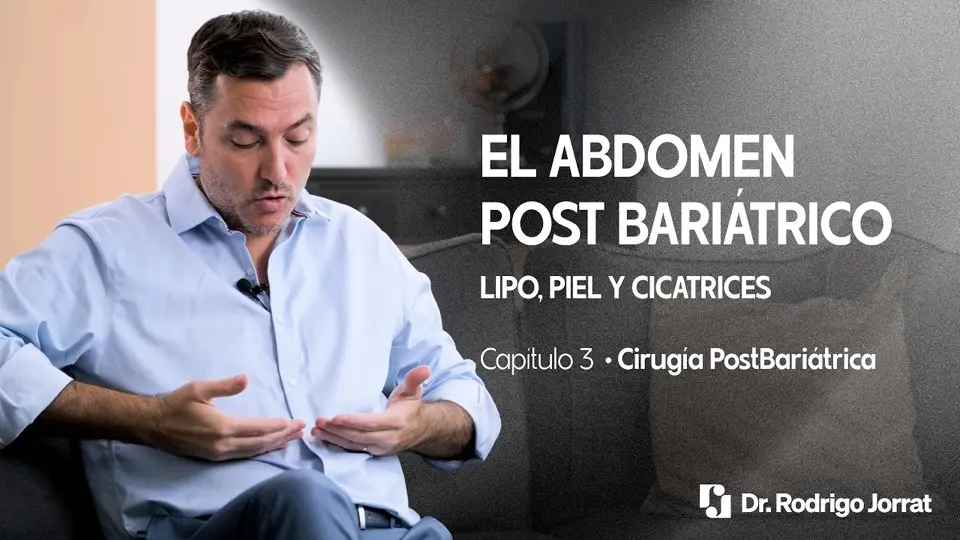
The abdomen is almost always the first consultation after massive weight loss: it defines your profile and it's what clothes can't hide. One of the first things I explain is that fat and excess skin are not treated the same way. Liposculpture reduces fat; dermolipectomy removes skin and excess tissue, and it leaves a scar.
Why the abdomen first
You stand sideways in front of the mirror and what you see is the abdomen. In a post-bariatric patient, something that was taut drops suddenly and can form an apron that sometimes reaches well below the abdominal line. That affects mobility, hygiene in the folds and something as simple as buttoning trousers. So when I ask what bothers you most, the answer is usually that area.
“I want to remove what's left over, but no scars”
I hear that sentence often, and it needs sorting out. Liposculpture lipoaspirates: with specific cannulas (with or without technology) it reduces the volume of the fat layers, front, back, 360 degrees, to give a more harmonious shape. A dermolipectomy removes the abdominal flap, that apron of skin, and usually repositions the navel. That means a scar.
In the vast majority of my post-bariatric patients the indication is a circumferential dermolipectomy, the 360: treating the excess skin front and back, and tightening and shaping the body from there. Lipo alone does not remove skin.
What is the fleur-de-lis?
When the excess skin is also significant in the central and upper abdomen (the “double bubble”, sometimes triple), a vertical resection in addition to the horizontal one can be considered. The scar runs from the sternum to the pubis and combines with the horizontal one, even with a 360. It's an option for selected cases, and the additional vertical scar is something that must be discussed very clearly before deciding.
The abdominal wall: diastasis
The rectus muscles of the abdomen are wrapped in aponeurotic sheaths that join at the midline. Pregnancies, increased abdominal and intra-abdominal fat, weight loss or previous surgery can separate those muscles: that is diastasis. After each pregnancy the wall comes back, but not to zero; from the third onwards, the abdomen often bulges in profile.
Correcting diastasis means bringing the rectus muscles back together with sutures, sometimes combined with mesh if there is an associated hernia, to recover the abdominal “corset”. Combined with dermolipectomy, it's what allows a flatter abdomen when standing.
Technology: what it's for and what it isn't
The trend moved from treating only the skin to also treating its elasticity, muscle volume and, in the latest wave, rib remodelling. There are lasers, temperature-based technologies and surgical radiofrequency, which is the one I prefer for its results and, above all, its safety profile. Used alone it isn't enough: today it's combined.
Something that changed my paradigm: the post-bariatric patient stopped being, for me, a purely reconstructive patient. With the right selection, they deserve the same chance of an aesthetic result as anyone else.
The technique must adapt to the patient, not the patient to the technique. That's why there are many techniques, and the essential thing is to choose the right one.
Frequently asked questions
Can excess skin be removed without a scar?
No. Removing skin is a dermolipectomy and it leaves a scar. Liposculpture reduces fat through small incisions, but it doesn't solve significant excess skin.
What is a 360 dermolipectomy?
A circumferential approach that treats excess skin on the abdomen and the back of the trunk. It's the most frequent indication in my post-bariatric patients, but it isn't automatic for everyone.
What is rectus diastasis and how is it corrected?
The separation of the abdominal rectus muscles. It's corrected by bringing them together with sutures (plication), sometimes with mesh if there is an associated hernia. It's assessed in consultation, not from a photo.
Does radiofrequency replace surgery?
No. It's a tool that can improve skin retraction combined with surgery. On its own, with significant excess skin, it isn't enough.
The information in this article is general and does not replace an individual evaluation.