Brachioplasty after major weight loss: scars and recovery
 Dr. Rodrigo Jorrat · Plastic surgeon · Buenos Aires · Lic. MN 1229033 min read
Raising your arms and feeling the skin hang is a common consultation after significant weight loss, especially when the heat arrives along with short sleeves and tank tops. Brachioplasty removes that excess skin and fat. But the central point must be said from the start: it leaves a visible scar.
When it's considered
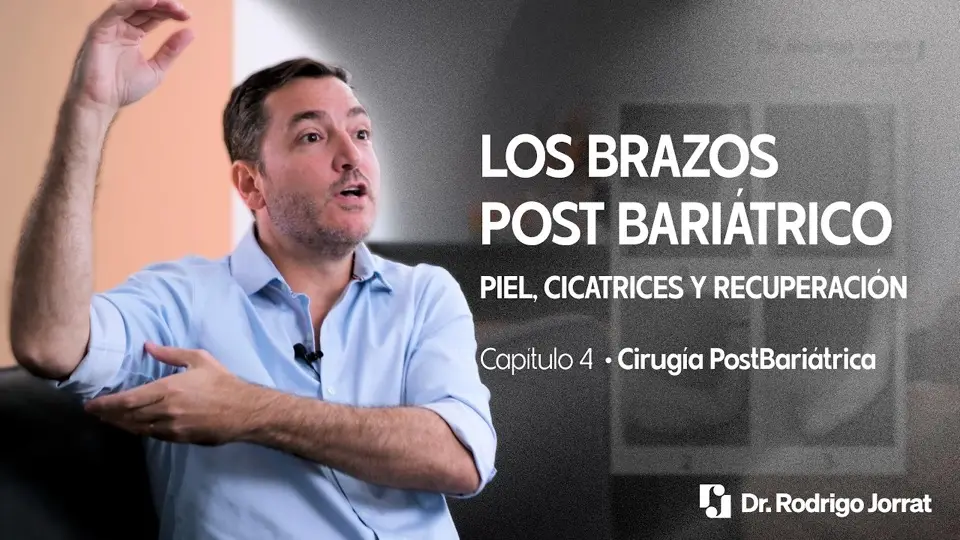
The arms are one of the three areas that sag most in post-bariatric patients, together with the abdomen and the legs (and in women I usually add the breasts). There are international classifications by degree, but the assessment in consultation is simple: if the skin stretches and hangs when you raise your arm, if it sticks out forward or backward when you lower it, if the folds sometimes get inflamed, and above all if a tight T-shirt squeezes and bothers you, you are a candidate for brachioplasty.
The scar, plainly
If I operate on the abdomen, a T-shirt covers the scar. On the breasts, I cover them. On the legs, even if the scar runs from groin to knee, I cover it. The arms, no: we spend less and less time in a sweater or jacket. It's a visible scar, and I have to explain that to every patient.
It's a tailor's job: taking in the clothes that became too big for the mannequin. It can't be done without a seam. The suture sits on the inner side of the arm, but in summer, raising your arms at the beach or in a pool, it will show. If I accept a brachioplasty, I accept a scar. If I don't accept a scar, I can't have a brachioplasty.
In selected cases, with little excess skin, there are alternatives: liposculpture with tightening technology, or a mini brachioplasty with the scar in the armpit. That one also shows when you raise your arms, though less.
How a scar evolves
I have a saying: patients scar the way they can, not the way they want. I've seen a two-centimetre incision end up as a hypertrophic scar, and a full 360 that at six months was almost a line. That said, there are treatments to improve them: laser, injections of different medications and pressure therapy, which I learned treating burn patients: a silicone gel sheet or a special dressing that applies constant pressure on the scar for several hours a day. It's a combination, and it always depends on how each person heals.
Recovery
Brachioplasty has its own timeline, and the goal is to recover as soon as possible without doing anything that harms the process. Should the arms stay still? No. You need to move, live your life; hardly anyone can go a week without moving their arms. We use physiotherapy and compression sleeves for extra safety.
The first 48 hours bring the most swelling: the arms can even look bigger than before, and that's normal. During that time I ask for the most care: have someone help you wash your hair, for example. After that, normal life. Return to work is defined by your activity and your progress; in general it's faster than people imagine.
The long-term result
I split it in two. In non-bariatric patients the result is much more stable and I can combine technology, liposculpture or a mini brachioplasty. In post-bariatric patients, the skin has less strength because of protein absorption, and the arms are an area in constant motion: they tend to loosen a bit more than the abdomen or legs.
We'll tighten as much as we can, but there is a real possibility of needing a scar or tightening revision later on. It may or may not happen; what can't happen is that you don't know beforehand.
Brachioplasty is not a minor surgery: it's a conscious decision, because it leaves visible scars and I must explain that this will exist.
Frequently asked questions
Where is the brachioplasty scar?
On the inner side of the arm. Its length depends on how much skin and tissue must be removed. It's visible when raising the arms and with short sleeves.
Can I move my arms after surgery?
Yes, and you should. Careful mobilisation, physiotherapy and compression sleeves are part of recovery. The first 48 hours are the most swollen.
Can the arm be operated without a long scar?
In cases with little excess skin, liposculpture with technology or a mini brachioplasty with an armpit scar is considered. If the excess skin is significant, the long scar is unavoidable.
Can scars be treated afterwards?
Yes: silicone sheets and pressure therapy, laser, injections. Not all scars need the same thing or respond the same way.
The information in this article is general and does not replace an individual evaluation.